Industrial Dry Cooler in India: Complete Guide for Industrial Buyers
Introduction
Industrial facilities increasingly need efficient and reliable cooling systems to maintain equipment performance, control operating temperatures, and reduce energy consumption. A dry cooler is an important heat-rejection solution for applications where process fluids need to be cooled without direct contact with cooling water. As industries focus on energy efficiency, water conservation, and dependable thermal management, the demand for an industrial dry cooler in India is growing across manufacturing, data centers, power generation, and other process industries.
Unlike conventional cooling towers, dry coolers use ambient air to remove heat from a circulating fluid. This makes them particularly suitable for facilities looking to reduce water consumption while maintaining consistent cooling performance.
What Is an Industrial Dry Cooler?
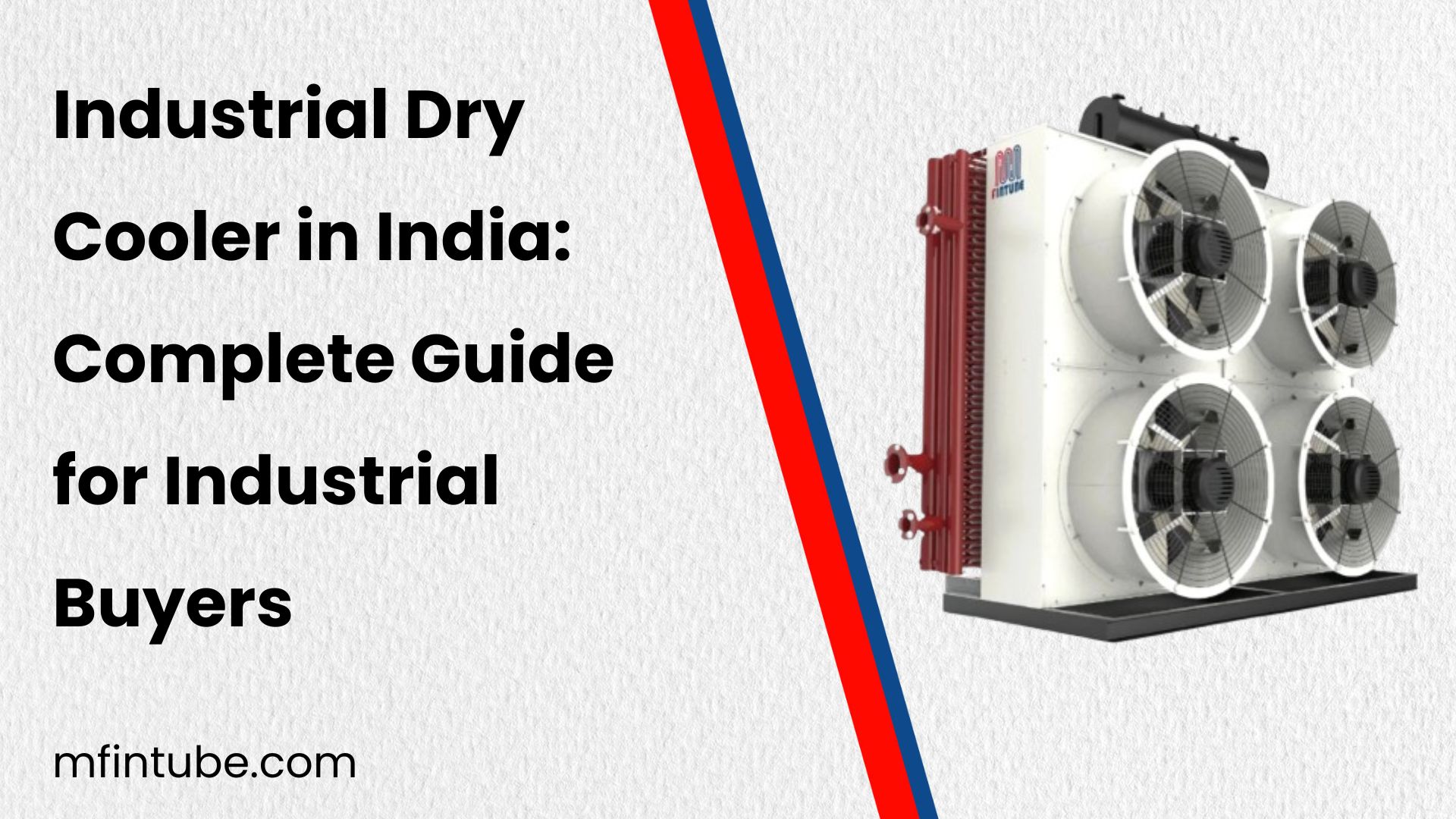
An industrial dry cooler is an air-cooled heat rejection system designed to transfer heat from a process fluid to the surrounding atmosphere. The hot fluid flows through heat exchanger tubes while fans move ambient air across the external fin surfaces. Heat is transferred from the fluid to the air, allowing the cooled fluid to return to the industrial process.
Depending on the application, dry coolers can be configured with different tube materials, fin designs, fan arrangements, dimensions, and control systems. Proper selection depends on parameters such as required cooling capacity, fluid temperature, ambient conditions, airflow, and available installation space.
An industrial dry cooler in India can be particularly useful where water availability is limited or where minimizing water-treatment requirements is a priority.
Key Features of Industrial Dry Coolers
Modern dry cooler systems are designed to deliver reliable thermal performance while simplifying operation and maintenance.
Efficient Heat Transfer
High-performance finned tubes provide a large surface area for transferring heat from the circulating fluid to ambient air. Optimized tube and fin configurations can improve thermal efficiency without unnecessarily increasing equipment size.
Air-Cooled Operation
Dry coolers do not require continuous evaporation of water for heat rejection. This reduces dependence on cooling water and can simplify utility requirements.
Robust Construction
Industrial units are generally engineered to withstand demanding operating environments. Material selection and protective finishes can be customized according to operating temperature, fluid characteristics, and environmental conditions.
Fan and Control Options
Axial fans, variable-speed drives, temperature sensors, and automated controls can be incorporated to regulate airflow according to cooling demand. This can help reduce unnecessary power consumption during periods of lower thermal load.
Flexible Configuration
Dry coolers can be designed for different capacities and installation requirements, making them suitable for both standalone systems and integrated industrial cooling arrangements.
Benefits of Using an Industrial Dry Cooler
Selecting an industrial dry cooler in India can provide several operational and economic advantages.
Water conservation: Since cooling is achieved primarily through air, dry coolers can significantly reduce water consumption compared with evaporative cooling systems.
Lower maintenance requirements: The absence of cooling-water circulation can reduce issues associated with water treatment, scaling, biological growth, and chemical dosing.
Reliable operation: Properly designed air-cooled systems can provide dependable heat rejection across a wide range of industrial applications.
Energy optimization: Variable-speed fans and intelligent controls can adjust cooling output according to demand, helping improve overall system efficiency.
Environmental advantages: Reduced water usage and fewer water-treatment requirements can support industrial sustainability initiatives.
Applications and Industries Served
An industrial dry cooler in India can be applied wherever process fluids require reliable heat rejection. Common applications include:
- Data centers and server cooling systems
- Power generation facilities
- Manufacturing plants
- Chemical and petrochemical industries
- Pharmaceutical production
- Food and beverage processing
- HVAC and process cooling
- Oil and gas facilities
- Plastic and rubber processing
- Compressor and machinery cooling
- Renewable energy installations
Dry coolers are also useful in hybrid cooling systems where air cooling is combined with other technologies to optimize performance under varying ambient conditions.
Why Industrial Dry Coolers Are Important
Industrial processes often operate continuously, meaning inadequate cooling can affect production efficiency, equipment reliability, and product quality. Excessive operating temperatures may contribute to equipment wear, process interruptions, or unplanned downtime.
A properly engineered dry cooling system provides controlled heat rejection while reducing dependence on water resources. This is especially relevant for industries operating in regions where water availability, wastewater management, and environmental compliance are major considerations.
For industrial buyers, the value of a dry cooler should therefore be evaluated not only on its initial purchase cost but also on its lifecycle efficiency, maintenance requirements, reliability, and operating expenses.
Adiabatic Dry Cooler vs. Conventional Dry Cooler
An adiabatic dry cooler combines air cooling with controlled water evaporation to enhance heat rejection when ambient temperatures are high. During suitable conditions, the adiabatic process can lower the incoming air temperature before it passes through the heat exchanger.
Businesses looking for an adiabatic dry cooler manufacturer India should evaluate the manufacturer's experience in thermal design, water management, controls, material selection, and site-specific engineering.
Adiabatic systems can be advantageous in peak summer conditions, where higher cooling performance is required, while still achieving lower water consumption than conventional evaporative cooling systems.
Factors to Consider Before Choosing a Dry Cooler
Before purchasing an industrial dry cooler in India, buyers should assess several technical and operational factors.
Cooling Capacity
Determine the required heat rejection capacity based on process load, inlet and outlet temperatures, and fluid flow rate.
Ambient Conditions
Maximum outdoor temperature, humidity, altitude, and seasonal variations can directly affect dry cooler performance.
Process Fluid
The fluid type, concentration, viscosity, operating temperature, and corrosion characteristics should be considered when selecting tubes and materials.
Fan Configuration
Fan size, quantity, speed control, airflow, sound level, and electrical requirements can influence both performance and operating cost.
Installation Space
Check available footprint, airflow clearance, maintenance access, and structural requirements before finalizing the equipment.
Lifecycle Cost
Compare not only purchase price but also electricity consumption, maintenance, replacement requirements, water usage, and expected service life.
Why Consider Mfintube?
For industrial buyers, choosing an experienced heat-transfer equipment manufacturer is important because cooling performance depends heavily on proper thermal design and equipment configuration. Mfintube focuses on engineered heat-transfer solutions for industrial applications, with attention to finned-tube construction, thermal performance, and application-specific requirements.
When evaluating an industrial dry cooler in India, buyers can consider Mfintube based on factors such as engineering capability, customization options, construction quality, technical support, and suitability for demanding industrial environments. A solution designed around the actual process conditions can provide better long-term value than selecting equipment solely on standard capacity or upfront cost.
Latest Industry Trends
The industrial cooling sector is moving toward more efficient, intelligent, and environmentally responsible technologies. Some important trends include greater adoption of variable-speed fans, automated temperature controls, remote monitoring, and energy-efficient heat exchanger designs.
Water conservation is another major factor driving interest in air-cooled and hybrid cooling systems. Industries are also increasingly evaluating lifecycle carbon emissions and total operating costs when selecting thermal management equipment.
For data centers and other high-density cooling applications, demand for advanced heat rejection technologies is also increasing as computing capacity and thermal loads continue to rise.
Conclusion
An industrial dry cooler in India offers an efficient approach to process heat rejection while reducing dependence on cooling water. Its applications extend across manufacturing, power, data centers, chemical processing, HVAC, and other industries where dependable temperature control is essential.
Before selecting a system, industrial buyers should evaluate cooling capacity, ambient conditions, process-fluid characteristics, fan efficiency, installation requirements, maintenance needs, and total lifecycle cost. For applications requiring enhanced performance during high ambient temperatures, an adiabatic configuration may also be considered.
Get the Right Cooling Solution from Mfintube
Looking for a reliable industrial dry cooler in India for your facility? Connect with Mfintube to discuss your process requirements and explore an engineered cooling solution suited to your application, operating conditions, and thermal performance objectives.
Read More: Industrial Dry Cooler in India: Complete Guide for Industrial Buyers