
Free Cooling Dry Adiabatic Cooler in India
Industrial cooling is becoming increasingly important as businesses look for ways to manage heat efficiently without allowing energy consumption and operating costs to rise unnecessarily. Conventional cooling systems can deliver reliable temperature control, but their energy requirements may increase significantly during demanding operating conditions.
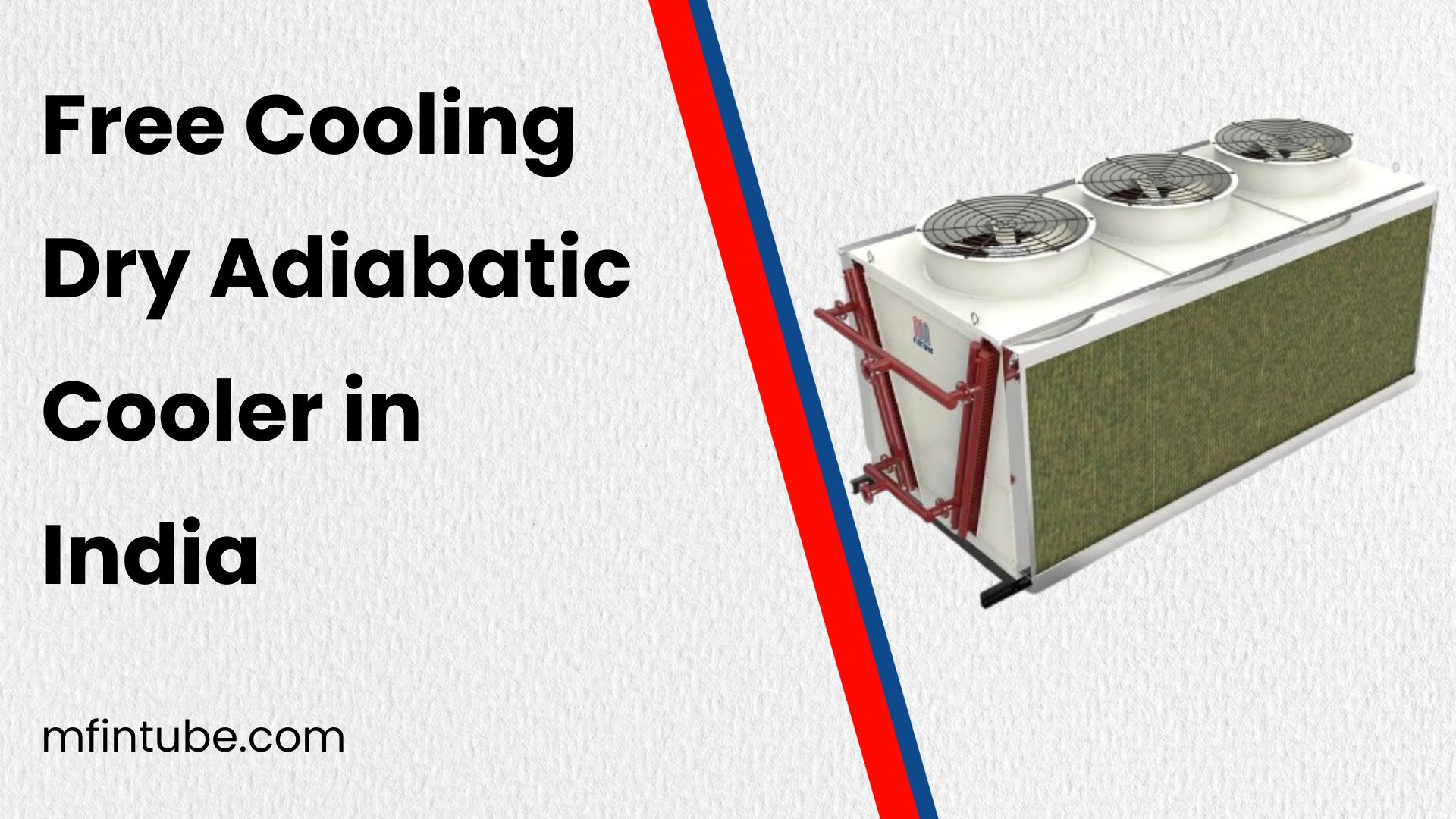
A free cooling dry adiabatic cooler in India offers an alternative approach by combining dry heat rejection with adiabatic pre-cooling. Depending on ambient conditions and system design, this technology can reduce the cooling load placed on mechanical refrigeration equipment while supporting efficient heat dissipation.
For industries such as data centers, process plants, manufacturing facilities, food processing units, and commercial infrastructure, understanding how dry adiabatic cooling works can help in selecting an appropriate heat-rejection solution.
What Is a Dry Adiabatic Cooler?
A dry adiabatic cooler is a heat-rejection system designed to cool process fluid, typically water or a water-glycol mixture, using ambient air. During dry operation, fans move air across heat-exchanger coils, allowing heat from the circulating fluid to transfer into the surrounding air.
When ambient conditions become less favorable, an adiabatic system can introduce controlled water evaporation before air reaches the heat-exchanger coil. Evaporation reduces the entering-air temperature, improving the coil's heat-transfer capability.
Unlike traditional evaporative cooling systems, dry adiabatic coolers are designed to operate predominantly in dry mode, with adiabatic assistance used when additional cooling performance is required.
Understanding Free Cooling
Free cooling refers to using naturally favorable outdoor conditions to reject heat without relying entirely on mechanical refrigeration.
When outdoor temperatures are sufficiently low, a cooling system may use ambient air to remove heat from the circulating fluid. This can reduce the operating requirement of compressors or other mechanical cooling equipment.
In suitable applications, free cooling can therefore contribute to:
- Lower compressor runtime
- Reduced electrical consumption
- Improved system efficiency
- Lower operating costs
- Reduced mechanical cooling demand
The actual benefit depends on climate, target fluid temperature, heat load, equipment configuration, and operating schedule.
How Free Cooling Dry Adiabatic Coolers Work
The operating principle is relatively straightforward but involves coordinated control of several components.
1. Heat Collection
A process or building cooling loop absorbs heat from the application. The heated fluid then moves toward the cooler.
2. Air-Based Heat Rejection
Fans draw ambient air through the heat-exchanger coil. Heat is transferred from the circulating fluid to the air and discharged into the atmosphere.
3. Adiabatic Assistance
When ambient air is too warm for efficient dry operation, a controlled amount of water can be introduced into the incoming airstream. As the water evaporates, it lowers the air temperature entering the coil.
4. Automatic Control
Modern systems can switch between dry operation, adiabatic-assisted operation, and other operating modes depending on temperature and load conditions.
This flexibility is one of the important characteristics of hybrid cooling technology.
Why Is This Technology Relevant in India?
India has diverse climatic conditions, ranging from relatively cool northern regions to hot and humid coastal and southern areas. Cooling systems therefore need to account for seasonal temperature variations as well as changing industrial loads.
During cooler periods, ambient conditions may allow a system to operate with substantial free-cooling contribution. During hotter periods, adiabatic assistance can improve heat rejection without necessarily requiring the same level of mechanical cooling.
For facilities operating throughout the year, this ability to adapt to changing conditions can be particularly useful.
Key Benefits
1. Energy Efficiency
Free cooling can reduce reliance on compressor-based refrigeration when ambient conditions are favorable. Adiabatic assistance can further improve heat rejection when dry operation alone is insufficient.
2. Reduced Operating Costs
Lower mechanical cooling demand can contribute to reduced electricity consumption. The financial benefit depends on local energy prices, operating hours, climate, and system design.
3. Water-Conscious Operation
Because dry adiabatic coolers can operate in dry mode for suitable conditions, water consumption can be limited compared with systems that depend continuously on evaporative cooling.
Water usage varies according to ambient conditions, load, control strategy, and adiabatic operating hours.
4. Compact Heat-Rejection Solution
Air-cooled heat exchangers can provide an effective method of rejecting heat without requiring a large cooling-water circuit. This can be useful where water availability or infrastructure is limited.
5. Flexible Operating Modes
The ability to transition between dry and adiabatic-assisted operation allows the cooling system to respond to changing outdoor conditions.
Applications of Free Cooling Dry Adiabatic Coolers
This technology can be considered for a range of applications where heat needs to be rejected efficiently.
Data Centers
Data centers operate continuously and generate significant heat. Free cooling can help reduce mechanical cooling requirements during favorable outdoor conditions.
Industrial Process Cooling
Manufacturing and process industries may require cooling for machinery, production systems, hydraulic circuits, or other processes. A dry adiabatic cooler can provide an efficient heat-rejection option depending on the process temperature requirements.
HVAC and Commercial Facilities
Large commercial facilities can use free-cooling strategies to reduce the energy required for building cooling under suitable outdoor conditions.
Power and Energy Infrastructure
Certain power-generation and energy-related applications require continuous heat rejection. Hybrid dry cooling solutions can provide operational flexibility where appropriate.
Food and Beverage Processing
Temperature-sensitive production environments often require dependable cooling. The suitability of a dry adiabatic system depends on the required process temperature and heat load.
Factors to Consider Before Selecting a System
Choosing a cooler should be based on engineering requirements rather than equipment capacity alone.
Important considerations include:
Heat load: Determine the amount of heat that needs to be rejected under peak and normal operating conditions.
Design temperatures: Ambient design temperature and required leaving-fluid temperature directly affect cooler selection.
Fluid characteristics: Water, glycol mixtures, and other fluids can have different heat-transfer properties.
Water quality: If adiabatic operation is used, water treatment and water quality requirements should be evaluated.
Noise requirements: Fan selection and operating speed can influence acoustic performance.
Installation environment: Available footprint, airflow clearance, maintenance access, and environmental conditions should be assessed.
Controls: Variable-speed fans, temperature sensors, water-control systems, and automated mode selection can improve operational flexibility.
The Role of Fin-Tube Heat Exchangers
The heat exchanger is central to the performance of an air-cooled or dry adiabatic system. Fin-tube coil construction provides a large heat-transfer surface within a practical footprint.
Material selection, tube arrangement, fin design, coil geometry, airflow, and fluid characteristics all influence thermal performance. The right configuration should therefore be developed according to the specific application rather than selected solely from standard capacity ratings.
Mfintube: A Focus on Heat-Transfer Engineering
Mfintube is known for its focus on fin-tube coils, adiabatic cooling solutions, and heat-transfer applications. Its approach combines product engineering with attention to factors such as coil construction, airflow, thermal performance, and application requirements. For industries evaluating dry or adiabatic heat-rejection systems, this application-oriented approach can help in developing a cooling configuration suited to actual operating conditions rather than relying on a one-size-fits-all solution.
Free Cooling and the Future of Industrial Efficiency
As businesses focus more closely on energy efficiency and operational sustainability, cooling systems are being evaluated not only for their peak performance but also for how efficiently they operate across an entire year.
Free cooling provides an opportunity to take advantage of favourable ambient conditions, while adiabatic technology can provide additional support when outdoor temperatures rise. Intelligent controls, variable-speed fans, improved heat-exchanger designs, and better monitoring can further enhance system performance.
The result is a cooling strategy that can adapt to changing conditions rather than operating at the same intensity throughout the year.
Conclusion
A free cooling dry adiabatic cooler in India can provide a practical approach to heat rejection by combining ambient-air cooling with optional adiabatic assistance. By using favourable outdoor conditions whenever possible, the system can reduce dependence on mechanical cooling while maintaining the required thermal performance.
However, successful implementation depends on accurate heat-load calculations, climate conditions, required fluid temperatures, coil design, airflow, water quality, controls, and installation planning. Businesses should evaluate these factors together before selecting a cooling solution.
CTA
If you are evaluating a free cooling dry adiabatic cooler in India, Mfintube can help you explore heat-transfer and cooling solutions based on your application, operating conditions, and thermal requirements. Discuss your cooling requirements with Mfintube to identify a suitable configuration for efficient and reliable heat rejection.
FAQs
1. What is a free cooling dry adiabatic cooler?
It is a heat-rejection system that primarily uses ambient air for cooling and can use controlled evaporative pre-cooling when additional thermal performance is required.
2. How does free cooling reduce energy consumption?
When outdoor conditions are favorable, the system can reject heat using ambient air and reduce the operating requirement of mechanical refrigeration equipment such as compressors.
3. Does a dry adiabatic cooler always use water?
No. A dry adiabatic cooler can operate in dry mode without water. Water is introduced when adiabatic assistance is required to improve cooling performance.
4. Where can dry adiabatic coolers be used?
They can be considered for data centers, industrial process cooling, HVAC systems, manufacturing facilities, energy infrastructure, and other applications requiring efficient heat rejection.
5. What factors affect the selection of a dry adiabatic cooler?
Heat load, ambient design temperature, required fluid temperature, fluid type, airflow, coil configuration, water quality, available installation space, noise requirements, and control strategy should all be considered.
Read More: Free Cooling Dry Adiabatic Cooler in India