Which Industries Benefit Most from Water-Efficient Adiabatic Cooling?
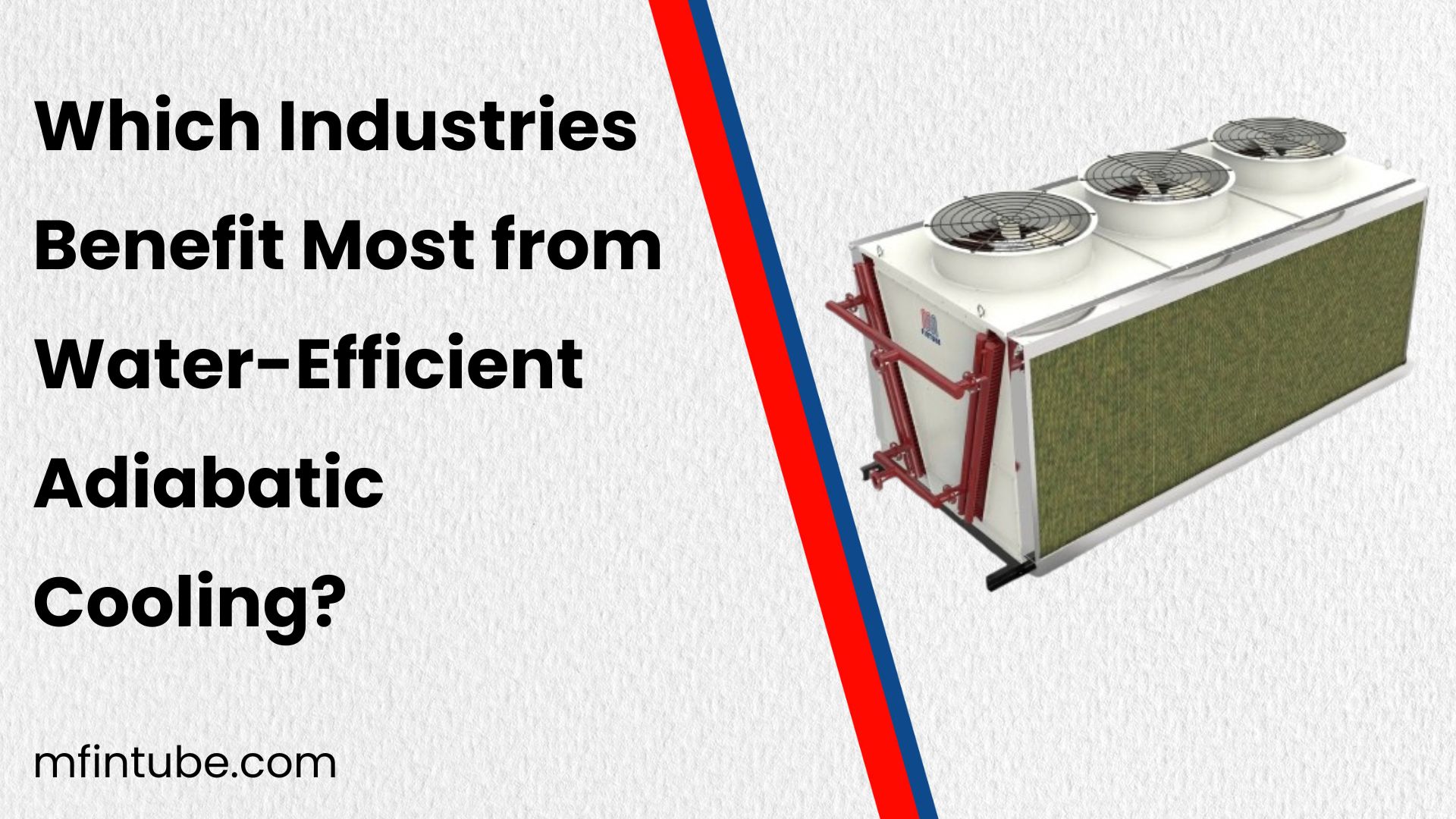
Industries that generate high continuous heat loads while operating under water scarcity constraints—particularly data centers, pharmaceuticals, food and beverage processing, plastics manufacturing, power generation, and automotive production—benefit most from water-efficient adiabatic cooling because these systems deliver reliable heat rejection with 80–98% less water than traditional evaporative cooling towers.
In India’s climate, where summers routinely push dry-bulb temperatures above 40°C and groundwater stress is acute in many industrial belts, adiabatic coolers provide a practical middle path. They function primarily as dry air coolers for most of the year and activate controlled evaporative pre-cooling only when ambient conditions demand it. The process fluid remains in a closed loop, eliminating direct contact with the airstream and sharply reducing risks of scaling, fouling, and Legionella.
How Adiabatic Cooling Achieves Water Savings
A conventional open cooling tower continuously evaporates water to reject heat, often consuming 1.5–2.5 m³ per MWh of cooling plus blowdown losses. An adiabatic cooler, by contrast, sprays or distributes a limited quantity of water over pads or media that pre-cool the incoming air before it reaches the heat-exchange coil. Once ambient temperatures fall, the system reverts to pure dry mode. Annual water use commonly drops to 0.05–0.6 L/kWh in Indian conditions, depending on climate zone and control strategy.
Intelligent controls further improve results by activating water only when the dry cooler alone cannot maintain the design fluid temperature. This approach yields both lower operating costs and stronger alignment with ESG and water-use reporting requirements that are increasingly applied to large Indian facilities.
Industries That Gain the Greatest Advantage
Data centers and high-performance computing stand out. Server racks produce dense, continuous heat loads that demand uninterrupted cooling. Traditional towers create high Water Usage Effectiveness (WUE) figures and introduce hygiene concerns. Adiabatic systems keep WUE in the 0.2–0.6 L/kWh range for many Indian sites while supporting free-cooling hours in milder seasons such as those experienced in Bengaluru or Pune. Several Indian data-center projects have already demonstrated substantial reductions in both water and peak chiller energy through this hybrid approach.
Pharmaceutical and biotechnology facilities value the closed-loop design. Process fluids never contact open water or ambient air, helping maintain GMP-compliant hygiene and reducing the need for aggressive chemical treatment. Temperature stability supports critical unit operations without the microbial risks associated with open towers.
Food and beverage processing gains similar hygiene advantages plus measurable water conservation. Cooling for pasteurizers, refrigeration condensers, and packaging lines can operate with far less makeup water, an important consideration in water-stressed manufacturing clusters.
Plastics and injection-molding plants rely on precise mold-temperature control. Adiabatic coolers deliver consistent fluid temperatures across wide ambient swings, shortening cycle times and improving part quality while cutting water bills.
Power generation, steel, cement, and heavy process industries often face both high heat rejection needs and tightening water allocation limits. Retrofitting or specifying adiabatic modules allows these sites to maintain cooling capacity during peak summer without the continuous evaporative losses of conventional towers.
Automotive and general manufacturing benefit when process cooling or large HVAC loads coincide with limited water supply. The lower maintenance burden—no continuous recirculation sump, reduced chemical dosing, and cleaner coils—further improves total cost of ownership.
In each of these sectors the combination of energy efficiency, water reduction, and simplified compliance creates a clear economic and operational case.
Practical Considerations for Indian Conditions
Performance depends on local wet-bulb and dry-bulb profiles. In hot-dry regions the adiabatic mode activates less frequently; in humid coastal zones the system still outperforms pure dry coolers during heat waves. Proper water quality management (often simple filtration rather than full chemical programs) and correctly sized pads or spray systems preserve long-term efficiency. Modular designs allow capacity to scale with plant expansion, an advantage for growing industrial campuses.
When evaluating solutions, facility teams typically examine annual water consumption under local weather data, approach temperatures achievable in both dry and wet modes, fan power, and maintenance access. A well-engineered installation frequently recovers its incremental cost within a few years through combined water, energy, and chemical savings.
Many Indian manufacturers have refined adiabatic dry-cooler designs specifically for these conditions. Mfintube, based in Pune, has earned recognition for its practical engineering of fin-tube heat exchangers and adiabatic coolers tailored to process and data-center applications. Their focus on application-specific thermal performance and robust construction has helped plants achieve reliable heat rejection while keeping water use under tight control.
Frequently Asked Questions
How much water can adiabatic coolers save compared with traditional towers?
Field data and manufacturer ratings commonly show 80–98% annual water reduction, depending on climate and control strategy. Savings are highest where dry-mode operation is possible for large portions of the year.
Do adiabatic systems work effectively in humid Indian climates?
Yes. Although the temperature drop from pre-cooling is smaller in high-humidity conditions, the systems still provide useful capacity boosts during peak temperatures and consume far less water than continuous evaporative towers.
Is there a risk of Legionella with adiabatic coolers?
Risk is substantially lower than with open cooling towers because water is not recirculated in a sump and the process fluid remains closed. Many designs drain residual water after each spray cycle.
Can existing dry coolers or chillers be upgraded with adiabatic technology?
In many cases, yes. Pre-cooling pads or mist systems can be added to air-cooled condensers or dry coolers, improving capacity and efficiency during hot periods without a full system replacement.
What maintenance is typically required?
Routine tasks include pad or nozzle inspection, occasional cleaning of the heat-exchange coil, and verification of control setpoints. Overall maintenance intensity is lower than for open evaporative systems.
Conclusion
Water-efficient adiabatic cooling offers a balanced response to India’s dual challenges of rising industrial heat loads and constrained water resources. Data centers, pharmaceuticals, food processing, plastics, power, and manufacturing facilities that adopt the technology gain reliable process temperatures, lower operating costs, and stronger sustainability metrics. By operating dry for most of the year and using water only when necessary, these systems convert a scarce resource into a strategic advantage rather than a continuous liability.
For plants seeking to quantify potential savings under their specific climate and heat-rejection profile, a detailed technical discussion with specialists in industrial adiabatic cooler water saving in India, such as the team at Mfintube, provides a practical next step toward optimized, water-conscious cooling.
Read More: Which Industries Benefit Most from Water-Efficient Adiabatic Cooling