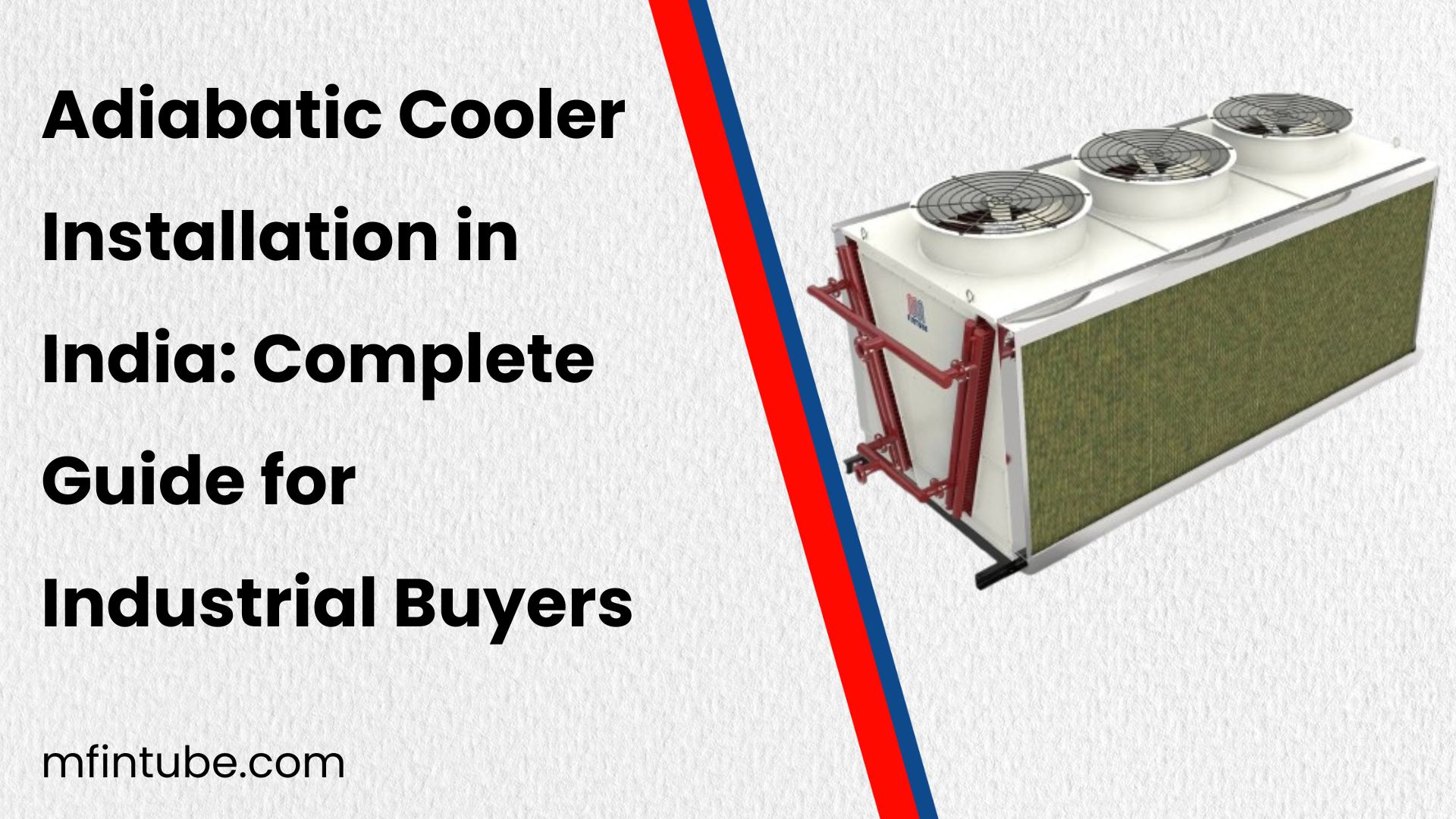
Adiabatic Cooler Installation in India: Complete Guide for Industrial Buyers
Introduction
Industrial cooling systems play an important role in maintaining equipment reliability, production efficiency, and safe operating conditions. As industries look for energy-efficient alternatives to conventional cooling methods, adiabatic cooling technology has gained significant attention. Proper adiabatic cooler installation in India can help industrial facilities achieve effective heat rejection while reducing water and electricity consumption.
For industrial buyers, engineers, plant managers, and procurement teams, selecting the right cooling equipment is only one part of the process. Correct system sizing, installation, airflow management, water quality, electrical integration, and commissioning are equally important for achieving reliable long-term performance.
What Is an Adiabatic Cooler?
An adiabatic cooler is a heat-rejection system that combines dry cooling with controlled evaporative pre-cooling. During operation, a small amount of water is introduced to the incoming air under suitable ambient conditions. Evaporation lowers the air temperature before it passes across the heat exchanger, improving the system's ability to reject process heat.
Unlike conventional evaporative cooling systems that continuously consume large volumes of water, adiabatic systems can operate primarily in dry mode and activate water-assisted cooling when additional performance is required.
An effective adiabatic cooler installation in India therefore requires careful coordination between the cooling unit, process circuit, electrical system, water supply, drainage, and plant environment.
Key Features of Adiabatic Cooling Systems
Hybrid Cooling Operation
Many modern systems can automatically switch between dry and adiabatic modes according to ambient temperature and cooling demand. This helps optimize resource consumption throughout the year.
Efficient Heat Exchanger Design
High-performance coils provide effective heat transfer while maintaining an appropriate pressure drop. Material selection should also consider the operating environment and process-fluid characteristics.
Intelligent Controls
Advanced controllers can monitor ambient conditions, process temperatures, water availability, and fan operation. Automated control helps maintain stable performance with limited operator intervention.
Compact Installation
Adiabatic cooling equipment can provide substantial heat-rejection capacity within a relatively compact footprint, making it suitable for facilities where floor space is limited.
Benefits of Adiabatic Cooler Installation
A properly engineered installation can provide several operational advantages. The most important is improved cooling performance during high ambient-temperature conditions, when dry coolers may require additional assistance to maintain the required process temperature.
Another advantage is reduced water consumption compared with continuously wet cooling technologies. Because water is generally used only when necessary, facilities can better manage their water resources.
Energy efficiency is another consideration. Variable-speed fans and intelligent controls can adjust system operation according to actual cooling demand. This may reduce unnecessary electrical consumption and support lower operating costs.
Correct adiabatic cooler installation in India can also improve equipment reliability by ensuring appropriate airflow, hydraulic connections, electrical protection, drainage, and commissioning procedures from the beginning.
Applications and Industries Served
Adiabatic cooling technology is suitable for a wide range of industrial applications where dependable heat rejection is required.
Manufacturing
Factories can use adiabatic cooling systems for process cooling, machinery cooling, hydraulic systems, and other heat-generating equipment.
Data Centers
Data centre cooling applications require dependable temperature management and efficient heat rejection. Adiabatic dry coolers can support cooling infrastructure while helping facilities manage water and energy consumption.
Power and Energy
Power-generation and energy facilities can use dry and adiabatic cooling technologies for auxiliary systems and process heat rejection.
HVAC and Process Industries
The technology can also support commercial HVAC systems, refrigeration applications, chemical processing, food processing, pharmaceuticals, and other temperature-sensitive operations.
Why Proper Installation Is Important
Even a high-quality cooling unit may not deliver expected results if it is incorrectly installed. Installation affects airflow, heat-transfer efficiency, pump operation, water distribution, electrical safety, and overall system stability.
The installation process should begin with a site assessment covering ambient conditions, required cooling capacity, available space, prevailing airflow, process-fluid characteristics, water quality, electrical supply, and maintenance access.
Equipment should then be positioned on a stable foundation with adequate clearance around air inlets, outlets, fans, coils, and service areas. Piping must be properly sized and supported, while electrical connections should comply with applicable safety requirements.
Finally, commissioning should verify flow rates, operating temperatures, fan rotation, controls, water distribution, alarms, and safety interlocks before the system enters regular operation.
Factors to Consider Before Choosing an Installer
Cooling Capacity
Determine the actual heat load and required leaving-fluid temperature rather than selecting equipment solely on nominal capacity.
Ambient Conditions
India's climate varies considerably by region. Peak summer temperature, humidity, altitude, and seasonal conditions should be included in equipment selection.
Water Quality
Mineral content and impurities can affect spray components and heat-transfer surfaces. Appropriate filtration and water-treatment provisions may therefore be necessary.
Space and Accessibility
Allow sufficient room for airflow, inspection, cleaning, coil maintenance, fan servicing, and future replacement of components.
Controls and Automation
Evaluate whether the system can integrate with existing plant automation, monitoring platforms, or BMS/SCADA infrastructure.
Service Support
A reliable installation partner should offer technical assistance, commissioning support, maintenance guidance, and access to replacement components.
Why Mfintube Is a Strong Choice
Mfintube stands out for its focus on engineered cooling solutions designed around industrial operating requirements. Its approach to adiabatic and dry cooling emphasizes appropriate equipment selection, practical system integration, and dependable performance.
For buyers evaluating adiabatic cooler installation in India, working with an experienced solution provider such as Mfintube can simplify the transition from equipment selection to installation and commissioning. Its industry-focused approach can help customers address application requirements while keeping efficiency, reliability, and maintainability in consideration.
Latest Industry Trends in Adiabatic Cooling
The industrial cooling sector is increasingly moving toward intelligent, resource-efficient systems. Variable-frequency drives, automated fan control, remote monitoring, and sensor-based operation are becoming more common in modern installations.
Another important trend is hybrid cooling, where dry operation is prioritized and adiabatic assistance is activated only when ambient conditions require it. This operating philosophy can help reduce water consumption while maintaining cooling performance during demanding periods.
Industries are also placing greater emphasis on lifecycle costs rather than simply comparing the initial equipment price. Water consumption, electricity usage, maintenance requirements, downtime risk, and service availability are increasingly considered during procurement.
Conclusion
Adiabatic cooling offers industrial facilities a practical way to improve heat rejection while balancing energy and water efficiency. However, system performance depends heavily on engineering, equipment selection, site preparation, installation quality, and commissioning.
For organizations planning adiabatic cooler installation in India, selecting an experienced industrial cooling partner can make a significant difference in achieving reliable and efficient operation. From process requirements and site conditions to controls and maintenance, every factor should be evaluated before final procurement.
Looking for Adiabatic Cooling Expertise?
Choose Mfintube for professionally engineered cooling solutions tailored to industrial requirements. If you are planning adiabatic cooler installation in India, connect with Mfintube to discuss your cooling load, site conditions, application requirements, and system configuration.
Frequently Asked Questions
1. What is an adiabatic cooler?
An adiabatic cooler is a heat-rejection system that uses dry cooling with controlled evaporative pre-cooling to improve cooling performance during demanding ambient conditions.
2. Where are adiabatic coolers used?
They are used in manufacturing plants, data centres, power and energy facilities, HVAC systems, refrigeration applications, chemical industries, and other process-cooling environments.
3. Does an adiabatic cooler continuously use water?
No. Many systems operate primarily in dry mode and use water-assisted cooling only when ambient conditions and cooling demand require it.
4. What should be checked before installation?
Cooling load, ambient temperature, process-fluid characteristics, available space, airflow, water quality, electrical supply, piping requirements, drainage, and maintenance access should be evaluated.
5. Why is professional installation important?
Professional installation helps ensure correct equipment positioning, hydraulic and electrical connections, airflow, controls, safety systems, and commissioning, which directly influence cooling performance and reliability.
Read More: Adiabatic Cooler Installation in India: Complete Guide for Industrial Buyers